
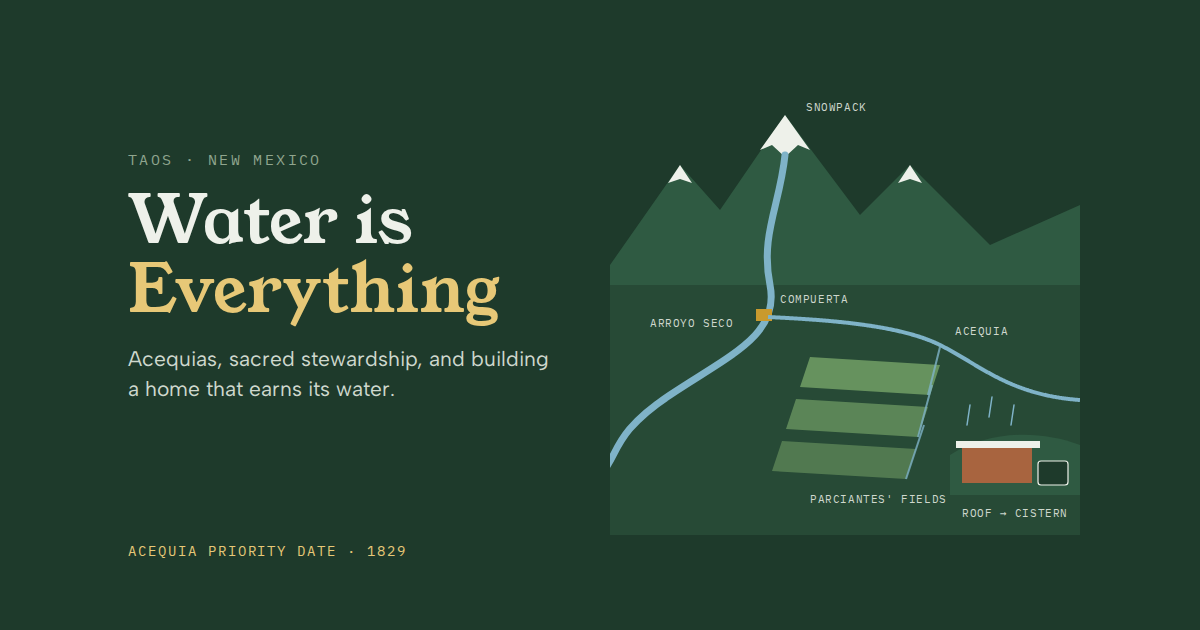
Water Is Everything: Acequias, Sacred Stewardship, and Building a Home That Earns Its Water
In northern New Mexico, water is not a utility. It is the oldest conversation happening in the landscape, a negotiation between mountains and desert, between snowpack and sky, between neighbors who have shared a ditch for four hundred years.
The acequia is where that conversation becomes governance.
An acequia is an irrigation canal, yes. But it is also a political body, a commons, a mutual obligation. The parciantes — the water right holders — elect commissioners and a mayordomo. They show up in the spring to clean the ditch together, shoulder to shoulder, because the ditch does not maintain itself and neither does community. They argue, they vote, they defer to the 1829 priority date that their great-great-grandparents earned when this valley was still part of Mexico. The water moves, and so does something harder to name: a living sense that the land is not just owned but tended.
At Pangea, we are building adjacent to one of the most ancient water-governed landscapes in the American West. The acequia that borders our land draws from Arroyo Seco Creek within the Antonio Martinez de Godoi Grant — one of the original land grants of the Spanish colonial period, its water rights recognized in a federal adjudication that took decades to resolve. The Taos Pueblo, whose relationship to this watershed predates all of that, holds the paramount water right. The acequia we participate in has a priority date of 1829. These are not historical footnotes. They shape every conversation we have about development, every line we draw on a site plan, every pipe we spec.
We take this seriously. And it has taught us something essential about how to build.
What Safe Water Actually Means Off-Grid
Most people, when they think about water safety, think about contamination — lead pipes, agricultural runoff, industrial discharge. Those are real problems. But for someone living fully off-grid in a high desert at 7,000 feet, water safety starts at a more fundamental level: Do you have water? Is it actually safe to drink? And can you maintain it without the infrastructure grid normally provides?
These are not simple questions. They require systems thinking — understanding water not as something that arrives at a tap but as something you harvest, store, treat, use, reuse, and return to the earth responsibly.
At Pangea, every home is designed around a complete water cycle. Here is what that actually looks like.
Rainwater harvesting begins at the roof. In Taos, average annual precipitation is around thirteen inches — modest, but not nothing. A properly designed catchment roof on a 2,000 square foot home can yield tens of thousands of gallons per year. That water is collected, filtered through first-flush diverters that discard the initial dirty runoff, and stored in large cisterns. This is the primary supply.
Filtration makes it potable. Roof-harvested water is not automatically drinking water. It carries dust, particulates, bird deposits, and whatever the air dropped on your roof before the rain did. A multi-stage filtration system — sediment pre-filter, activated carbon, UV sterilization — brings it to potable standard. The system must be maintained. Filters must be changed. UV bulbs must be replaced. This is not a “set it and forget it” situation, and anyone telling you otherwise is selling you something.
Greywater gets a second life. Water from sinks, showers, and laundry — greywater — is too good to send directly to waste. Properly managed, it can be redirected to toilet flushing and subsurface irrigation. This dramatically reduces your potable water demand. It also means paying close attention to what goes down your drains: conventional cleaning products, bleach, and synthetic fragrances disrupt the biological processes that make greywater reuse safe. The chemical choices you make inside your home have direct ecological consequences outside it.
Blackwater is treated botanically. Toilet waste — blackwater — cannot be handled the same way. At Pangea, we use botanical cell systems: constructed wetland-style treatment chambers filled with specific plant species that process waste biologically, producing effluent clean enough for subsurface discharge without contaminating groundwater. This is Earthship-derived technology, refined over decades of practice in exactly this climate. It works. It requires no chemicals. It grows food-adjacent plants. And it represents the most elegant solution we know to the problem of human waste in a place where water is precious and the aquifer is shared.
The Acequia Principle Applied at Scale
What the acequia tradition understands, and what most modern water management forgets, is that water safety is not just a personal problem. It is a collective one.
The reason an acequia works is that no one can abuse the ditch without everyone suffering for it. If a parciante upstream diverts more than their share, the parciante downstream goes dry. If someone dumps waste near the headgate, the whole system is compromised. The governance structure exists precisely because individual decisions about water have collective consequences.
The same is true at the scale of a home or a community. If one household uses chemical drain cleaners, those chemicals reach the shared soil. If one building’s catchment system is poorly maintained, it becomes a vector for contamination that can spread. If greywater is mishandled, it creates nuisance and risk for neighbors.
This is why Pangea’s approach to water is governance as much as engineering. We set standards for what chemicals can be used in the home. We orient new residents to their water systems before the first day of occupancy. We build redundancy into every critical system because in the high desert, a failed cistern pump is not an inconvenience — it is an emergency.
And we treat the acequia the way it deserves to be treated: as infrastructure older and more important than anything we are building, one that we are obligated to support, not simply extract from.
Making the Water Safe: A Practical Philosophy
We believe safe water in an off-grid setting requires three things that the conventional development industry rarely builds together:
Honest system design. Every water system we build is sized for actual use, not theoretical use. Cisterns are sized for multi-month storage buffers, not just average monthly demand. Filtration is specified to handle worst-case turbidity, not best-case tap water. The system should work hardest exactly when conditions are hardest — drought years, cold snaps, unexpected demand — and we design accordingly.
Resident competency. A system you cannot operate is not a system — it is a liability. Every Pangea resident is trained on their water systems before occupancy. They know how to read a cistern level, change a filter, check UV lamp output, inspect a first-flush diverter. This is not optional orientation. It is the difference between a home that functions for thirty years and one that fails in three.
Ecological accountability. Water that enters a home leaves it. Greywater reaches soil. Effluent reaches the water table. Roof runoff reaches the acequia. Every decision about water chemistry, system design, and maintenance has a downstream consequence — literally. We design for the full cycle because anything less is someone else’s problem, and in a community with a 400-year-old water governance tradition, “someone else’s problem” is not an acceptable answer.
A Different Kind of Thirst
Building in Taos has changed how we think about water. Not just as engineers — as people.
There is something that happens when you stop treating water as ambient infrastructure and start treating it as something you actively manage, steward, and account for. You become more attentive. You start to notice when the arroyo is running high after a monsoon and when it is barely a thread in a dry year. You understand, viscerally, why the acequia commission has been meeting every October since before New Mexico was a state.
Water is not a resource. It is a relationship — between your household and your land, between your land and its watershed, between your generation and the ones that come after. The acequia commissioners understood this four centuries ago. The best off-grid home design understands it today.
At Pangea, we are trying to build homes that are worthy of the water they use.
Pangea Design Build designs and builds fully off-grid biotecture homes on the land being developed as Pangea Community, Taos, New Mexico. Learn more at pangeabuild.com