
A house that collects, stores, treats and reuses.
Every Pangea home is designed as a closed loop. The same drop of water is used several times, the sun heats the house directly, and treated waste water goes back into the soil.
Energy
Your own power plant, sized to your home.
Each lot runs an independent renewable system: solar PV with battery storage. Homes are designed to run on their own power and stay resilient through the short, cloudy days of a Taos winter. In some locations, grid power may be available as a backup.
At more than 300 days of sunshine a year at close to 7,000 feet, northern New Mexico is one of the best solar resources in the country.
- Net-zero design targeting 100% on-site renewable energy
- Battery storage and inverters sized in Design Review
- Wiring and disconnects built to code and Design Review Professional bulletins
- Batteries, tanks and inverters screened from streets and neighbors
- Hands-on training in system operation, battery management and monitoring during orientation
The LSA provides technical resources, approved-vendor referrals and system standards.
Water
Rain and snow, caught where they fall.
The roof is the primary water source. Rain and snowmelt drain into an on-site cistern sized to the roof area and household. From there the water is filtered for drinking and household use.
A community well provides supplemental water. Landscaping must survive on precipitation, harvested water and recycled greywater.
On each homesite, more water is returned to the land through greywater reuse, irrigation and swale infiltration than the home draws.
- RoofCatches rain and snowmelt
- CisternStores the water on site
- FilterPotable water for the home
- PlantersGreywater is cleaned by interior plant beds
- ToiletFlushed with treated greywater
- Botanical cellsBlackwater is treated in contained cells
- LandscapeTreated water irrigates
Wastewater
Plants do the treatment.
Greywater from sinks and showers flows through interior botanical planters, which clean and treat it for toilet flushing and irrigation. Blackwater goes to a septic tank and then to an exterior, contained botanical cell system of at least three lined and contained cells, designed to a zero-groundwater-contamination standard. Every system is on its own lot. There are no shared sewer lines.
Systems use approved designs that meet New Mexico Environment Department requirements.
Living with a biological system
These systems depend on healthy microbes and plants, so a few household habits matter:
- No bleach, drain cleaners or antibacterial products
- Flush toilet paper only. No "flushable" wipes, paper towels or feminine products
- Use cleaning products from the approved compatible list
Heating & cooling
Comfort without a furnace.
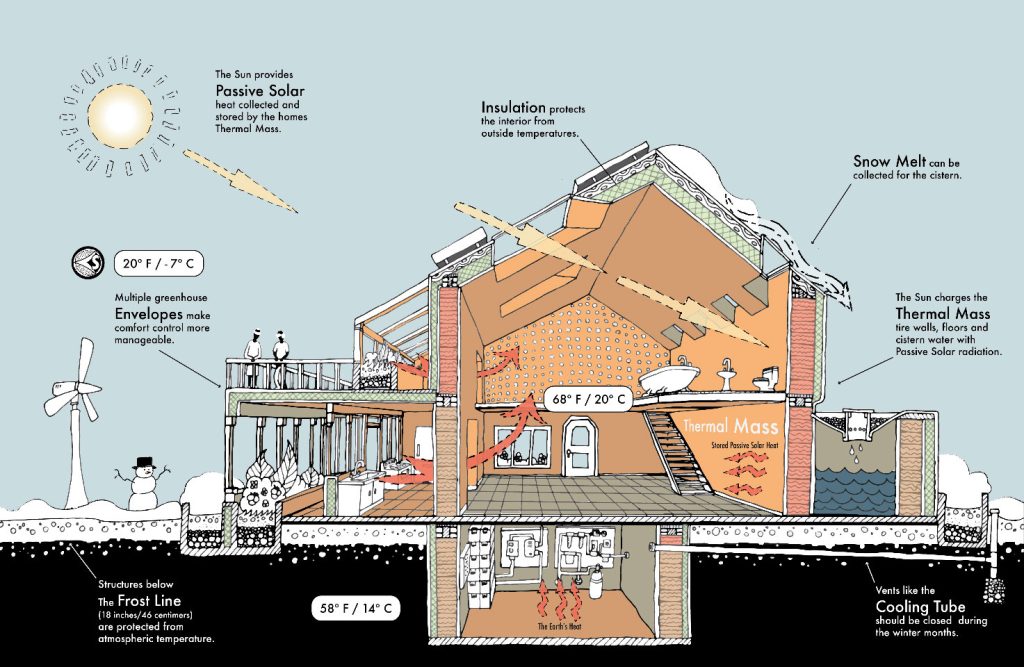
Passive solar design does the work that mechanical heating and cooling would do elsewhere.
- South-facing glass lets in the low winter sun and is shaded from the high summer sun.
- Thermal-mass walls store heat by day and release it through the night.
- Exterior insulation wraps the mass so the stored heat stays inside.
- Earth cooling tubes bring in air tempered by the ground, about 58 °F at depth.
- Operable high vents exhaust summer heat by stack effect.
Food & soil
Nothing leaves the loop.
Food waste becomes compost, compost builds soil, and the soil grows food in the community greenhouses and fields.
Earthship walipinis
In-ground passive-solar greenhouses that use thermal mass to grow produce all winter.
Regenerative farming
Composting, crop rotation, rotational grazing and water conservation are the basis of community life, not options.
Compost & recycling
Central composting, recycling stations and organic waste processing. Finished compost goes back to members' gardens.
Learn the systems before you move in.
Every new owner completes a hands-on Resident Systems Orientation before closing.