
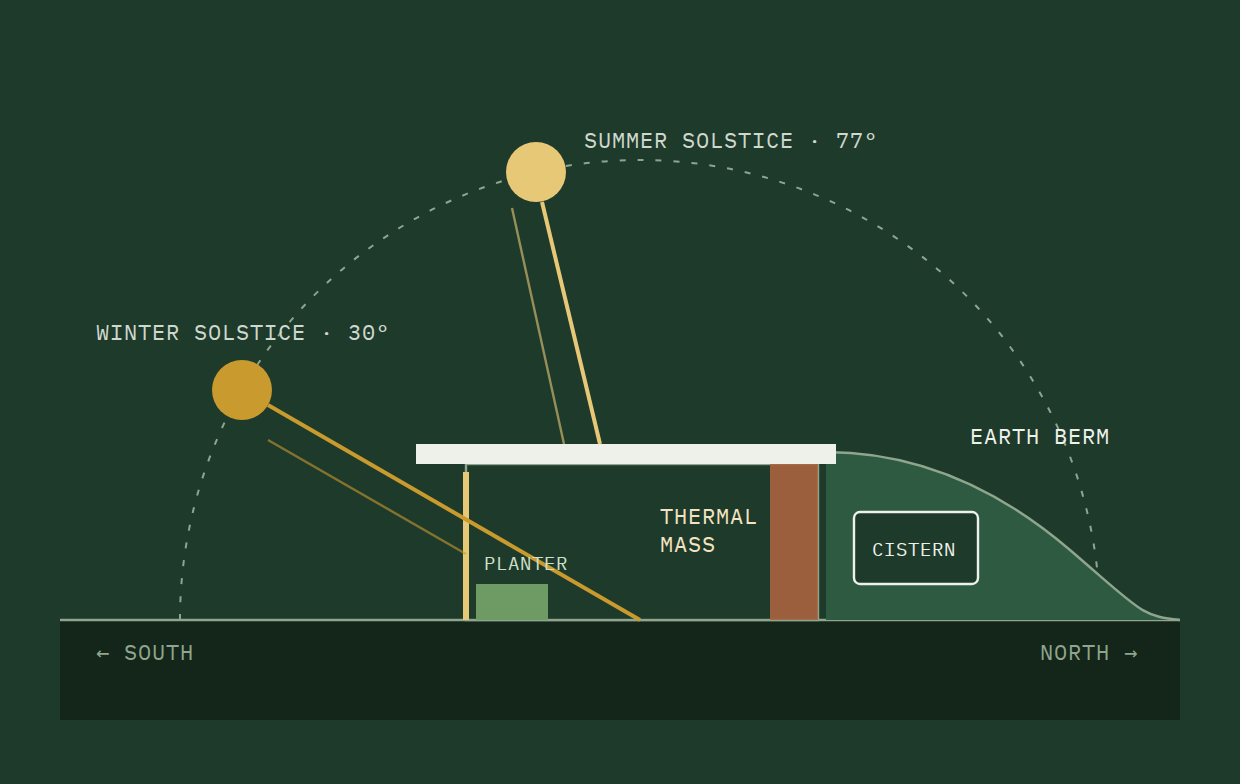
Winter in Taos is a study in contrasts. Nights drop well below freezing at 7,000 feet, and the days are some of the clearest and sunniest in the country. A conventional house fights that climate with a furnace and a fuel bill. A Pangea home is designed to work with it: catch the sun's heat during the day, store it in the walls, and keep it inside through the night.
No single piece of equipment does this. The design does, through three simple moves: catch, store and keep.
1. Catch: glass that faces the sun at the right angle
Every Pangea home is designed around the sun. The simplest case is main glazing that faces south, and that is the case shown here. Homes can face other directions too; Pangea adjusts the design to each site so the home still catches the winter sun. Either way, it all comes back to how the sun moves across the sky at our latitude.
At 36.4° north, the noon sun at the winter solstice sits only about 30° above the horizon. That low winter light streams through south-facing glass and reaches deep into the house, across the floor and onto the back walls. At the summer solstice, the noon sun climbs to about 77°. A roof overhang sized to the home's latitude lets the low winter sun in while blocking the high summer sun, which lands on the roof instead of the glass.
The same geometry that heats the house in January keeps it from overheating in July. That's the core of passive solar design: the building responds to the seasons on its own.
2. Store: heavy walls inside the house
Sunlight is only useful if the house can hold on to it. Pangea homes are built with heavy, earth-based walls: tire-rammed earth, adobe and compressed earth block. These materials have high thermal mass, which means they absorb a lot of heat slowly and release it slowly.
On a clear winter day, the sun warms the floors and interior walls for hours. After sunset, that stored heat radiates back into the rooms through the night. The mass also smooths out the swings. Instead of a house that's hot at 3 p.m. and cold at 3 a.m., you get one that stays steady.
3. Keep: insulation on the outside, earth on the north
Where the insulation goes matters as much as the mass. Our Architectural & Sustainability Guidelines require mass inside, insulation outside: the heavy walls sit on the warm side of a continuous layer of exterior insulation. The stored heat stays in the living space instead of leaking into the cold ground or the night air.
On the north side, homes are bermed into the earth. The berm shelters the house from winter wind and moderates temperatures year-round, and it's also where each home's water cistern sits, protected from freezing. Careful air sealing, to an airtightness target set each year through Design Review, keeps warm air from slipping out through gaps.
What about summer?
The same principles work in reverse. The overhang keeps the high summer sun off the glass. Earth cooling tubes draw outside air through buried pipes, where the ground is about 58 °F year-round, and deliver it cooled into the house. Operable high vents let warm air rise and escape, pulling that cooler air through the rooms. Interior botanical planters, which also treat the home's greywater, add green space and humidity to the dry high-desert air.
The result is a home that heats and cools itself without a furnace or air conditioner, designed from the start to stay comfortable through a Taos winter and summer alike.
Built to a standard, not a guess
Passive solar only works when it's done right, and small mistakes compound. Glass in the wrong place, an overhang an inch too long, or insulation on the wrong side of the wall can undo the whole system. That's why every home at Pangea, whether built by Pangea Design Build or an owner's own builder, goes through written Design Review against the same performance standards before construction begins.
It's also why every new owner completes the Resident Systems Orientation before closing. Living in a passive solar home is simple, and it helps to know how the house wants to be lived in: when to open the vents, how to use window coverings on the coldest nights, and why the sun on the floor in December is doing real work.
Learn more
- Heating & cooling on our Living Systems page
- Water is Everything: acequias, stewardship and a home that earns its water
- Homes & lots: one- and two-acre homesites, standard or custom designs
Thinking about joining? Request the Community Overview and we'll follow up personally to set up an introductory call.